
It’s the end of the month. You need to pay a contractor in Brazil, a supplier in Germany, and a business partner in Singapore.
Three payments. Three countries. Three potentially different ways to send money.
Each payment might be straightforward on its own. But which method should you choose for each recipient? The answer depends on the country, currency, cost, speed, and how the recipient can receive the funds.
For companies managing international business payments, relying on a single payment method rarely works across every country, currency, and recipient.

A payment method that works well in one market may be unavailable, expensive, or inconvenient in another. Businesses often need several options to reach international recipients.
Here are four common examples:
Country and availability
Common use
What to consider
Bank transfers
Supplier and corporate payments
Transfer fees, currency conversion, settlement time
Local payment systems
Payments to recipients in supported markets
Country coverage and recipient eligibility
International payment platforms
Contractor and supplier payouts
Fees, supported currencies, payout options
Stablecoins
Eligible cross-border business transfers
Blockchain networks, recipient access, conversion options
Each method serves a different purpose. The best choice depends on the payment itself and the needs of the person or business receiving it.
Before sending an international business payment, consider five practical factors.
Country and availability
Can the chosen method reach the recipient in their country? Are there restrictions on sending or receiving funds through that route? A payment option is useful only if both sides can access it.
Currency and conversion costs
Check whether the recipient can receive the payment in the required currency. Exchange rates, conversion fees, and intermediary bank charges can affect the final amount received.
Speed and settlement time
Some methods support near-instant transfers, while others take several business days. The expected arrival time matters when paying suppliers against deadlines or contractors on a regular schedule.
Recipient requirements
Different methods require different details. A bank transfer may need an IBAN or local account number, while a stablecoin transfer requires a compatible wallet address and blockchain network. Confirm the recipient’s details before initiating the payment.
Confirmation and records
Consider how you’ll confirm that the payment arrived and obtain the information needed for your records. Depending on the method, confirmation may come from a bank, payment provider, or blockchain transaction record.
The right method balances these factors. The fastest option may not be the cheapest, and the lowest fee may not make sense if the recipient cannot access the funds easily.
Imagine a company paying contractors in several countries. Some recipients may be able to receive bank transfers in their local currency, while others may prefer a supported stablecoin payout.
The company needs to check which methods are available in each market, compare the total cost, consider settlement times, and confirm what details each recipient must provide.
The choice may differ from one contractor to another. What matters is finding a suitable option for each payment without making the process unnecessarily complicated.

Choosing the right method for each transaction is one part of international payment operations. Businesses also need a reliable way to manage the payments they send.
Finance teams need to see which transactions are complete, review fees, and keep records for accounting and reconciliation. These tasks can become harder when payment details are spread across several providers and systems.
According to J.P. Morgan's Payments Outlook 2026, 87% of surveyed organizations have introduced some level of treasury and payments automation, yet only 39% describe their systems as mostly or fully automated.
This highlights a broader challenge: sending payments is only one part of the process. Businesses also need to track transactions, manage payment information, and maintain accurate records.
For businesses making international payments, this highlights the value of looking at the entire process, from sending funds to tracking transactions and maintaining records. Automating one step doesn’t necessarily connect all the others.
The aim is to give each payment a suitable route while keeping the overall process clear and manageable.
When stablecoins are the right fit for an international payment, DMaple helps businesses manage the entire process in one place — from organizing recipients and sending payouts to tracking transactions and keeping records.
Teams can add recipients, create individual or batch payouts, track payment statuses, review fees, and keep receipts and transaction records together. They can also export payment data for accounting and reconciliation.
DMaple also supports email-based stablecoin transfers, making it easier to initiate payments without collecting wallet addresses from every recipient.
This gives businesses a consistent way to manage stablecoin payouts, whether they’re paying one international contractor or handling batch payouts to multiple recipients.
Stablecoins are the payment infrastructure behind these transactions. The workflow stays focused on what the business needs to do: manage recipients, send payments, track progress, and keep records organized.
Explore DMaple for business to learn more about its international payment tools.
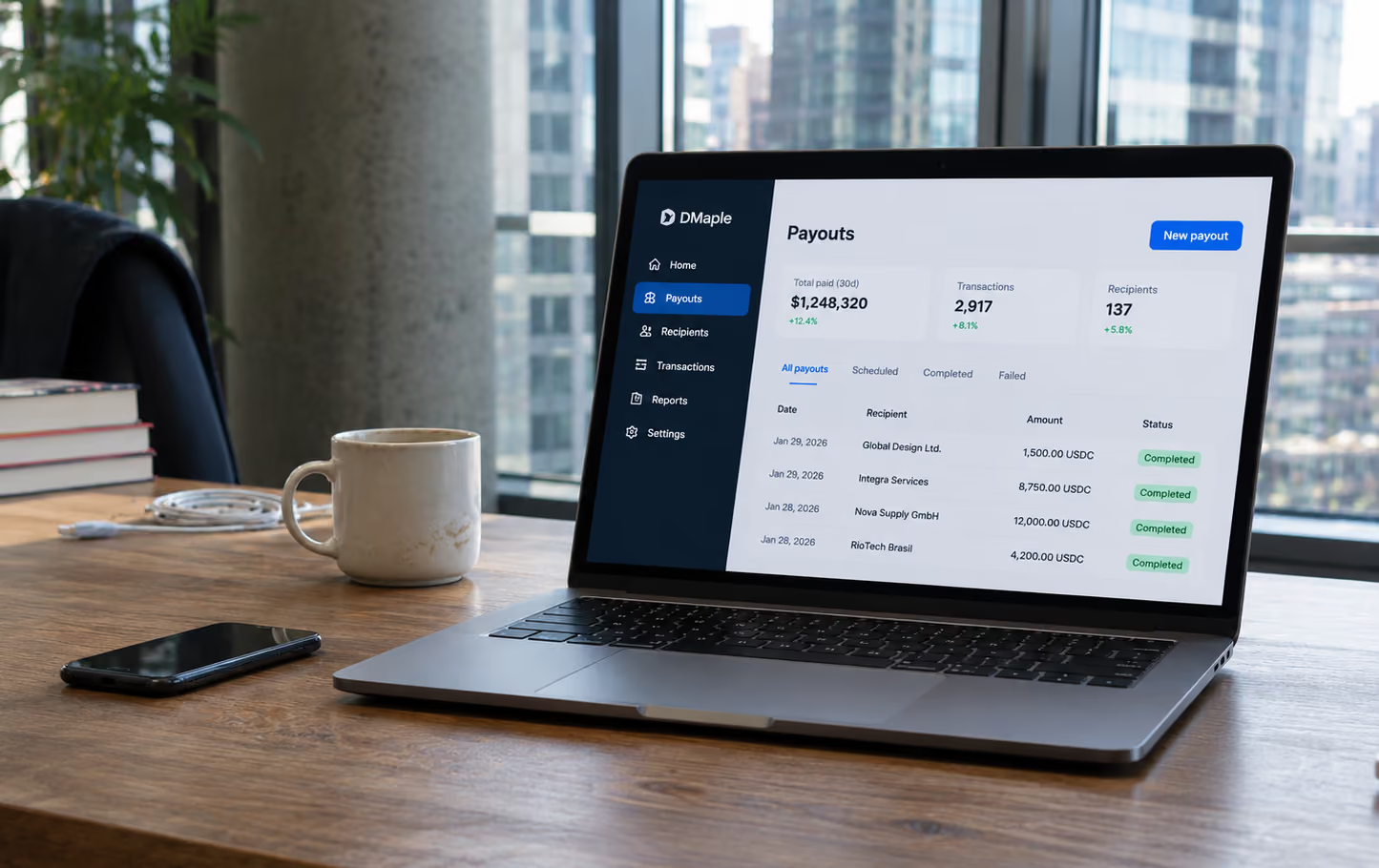
International payments work best when businesses can choose the right method for each recipient and keep the process organized. DMaple makes stablecoin payouts easier to manage as part of that workflow.
DMaple brings stablecoin payouts into one workflow.
Verify. Send. Track. Export. All in One Place.
New at DMaple Blog

DMaple Partners with Bridge to Expand Global Payout Capabilities
DMaple is integrating with Bridge, a Stripe company, to connect stablecoin payments with local currencies and domestic payment networks.
Learn more
International Business Payment Methods: Why One Isn’t Enough
Compare international business payment methods, including bank transfers, local payment systems and stablecoins. Learn how to choose the right option for each payout.
Learn more

The Hidden Cost of Running a Small Business
A contractor finishes a project for a company overseas. The payment is sent, the invoice is marked as paid, and the work is done.
Learn more